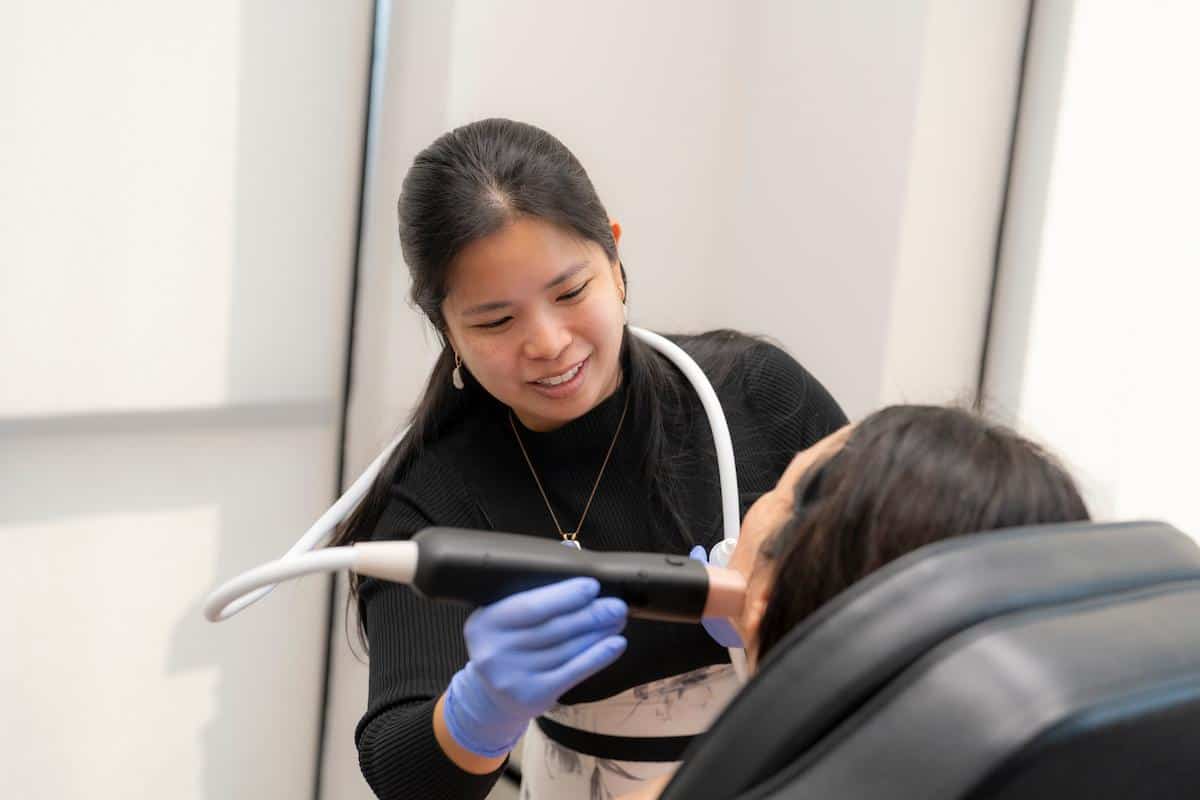
Written and reviewed by Dr. Samantha Mikals – a physician at Jacksonville Concierge Medicine – Aesthetics. Every treatment we offer is performed by a doctor — not delegated to a technician.
If you’ve been researching skin tightening in Jacksonville, you’ve almost certainly come across Morpheus8. It’s one of the most searched-for aesthetic treatments in our area, and for good reason — it’s a well-marketed radiofrequency (RF) microneedling device. But Morpheus8 isn’t the only RF option, and for a lot of patients, it isn’t the most comfortable one either.
Below, I’ll walk through how Morpheus8 works, how it compares to a newer RF system called Density by Jeisys, and why — for many of the patients we see — Density is the route we recommend.
What Is Morpheus8?
Morpheus8 by InMode is a fractional radiofrequency (RF) microneedling device. According to InMode, it’s cleared by the FDA for dermatological procedures requiring soft tissue contraction or coagulation. In plain terms: tiny needles penetrate the skin and deliver bipolar RF energy at different depths to stimulate collagen and tighten tissue.
InMode describes Morpheus8 Burst as able to deploy RF energy to multiple soft-tissue depths in a single pulse, with several interchangeable tips ranging from 12 to 40 pins depending on the treatment area and depth.
The trade-off is what comes with the needles:
- It’s minimally invasive. Microneedling means the skin is physically punctured, so the device is delivering energy through dozens of tiny wounds.
- Numbing is usually required. Most patients need topical anesthetic, and sometimes more, to tolerate the treatment.
- There is real downtime. Redness, pinpoint bleeding, and swelling for a few days afterward are common.
- Sensitive areas are harder. Delicate skin — like around the eyes — is more challenging to treat with a needle-based device.
None of this makes Morpheus8 a bad treatment. It’s just an invasive one. And for many of the concerns patients come to us with, you can get excellent collagen stimulation without putting needles through the skin at all.
What Is Density RF?
Density by Jeisys is a non-invasive, dual-mode radiofrequency device. Per Jeisys, Density is FDA-cleared for use in dermatologic and general surgical procedures for electrocoagulation and hemostasis. Where Morpheus8 uses needles, Density delivers its energy through the surface of the skin — no needles, no punctures.
What makes Density distinct is how it delivers RF. Jeisys reports that Density uses sequential monopolar and bipolar RF in a single pulse, which the company says helps it build collagen more effectively than monopolar RF alone, while staying comfortable. Two features support this:
- Adjustable cryogen cooling (five levels) to keep the surface of the skin comfortable during treatment.
- Real-time impedance calibration, which automatically adjusts energy delivery as it reads the skin — intended to make each treatment more consistent.
According to Jeisys’s published data, Density treatments are associated with increases in collagen and elastin fiber density. As with any aesthetic treatment, individual results vary — manufacturer data reflects studied conditions, not a guarantee of any specific outcome.
The Honest Side-by-Side
| Feature | Morpheus8 (RF Microneedling) | Density (Non-Invasive RF) |
|---|---|---|
| How energy is delivered | Needles puncture the skin | Through the skin surface — no needles |
| RF type | Bipolar RF | Sequential monopolar + bipolar RF |
| Numbing | Topical anesthetic usually needed | Generally no numbing required |
| Downtime | Redness, pinpoint bleeding, swelling for days | Little to none; mild redness for a few hours possible |
| Comfort during treatment | Variable; needle-based | Cooling-assisted, designed for comfort |
| Delicate areas (e.g., eyelids) | More difficult with needles | Suited to sensitive areas including the eyes |
| Skin types | Used across skin types | Designed for all skin types with real-time sensing |
Comparison reflects manufacturer descriptions from InMode and Jeisys. Both devices are FDA-cleared RF technologies; the differences above relate to the treatment experience and approach, not a claim that one produces medically superior results.
What the FDA Has Said About RF Microneedling
This is the part most clinics won’t mention, so I will. On October 15, 2025, the FDA issued a Safety Communication titled “Potential Risks with Certain Uses of Radiofrequency (RF) Microneedling.” Because Morpheus8 is an RF microneedling device, this guidance is directly relevant to anyone researching it.
According to the FDA, the agency is aware of reports of serious complications when RF microneedling devices are used for dermatologic or aesthetic skin procedures (treating wrinkles, “tightening,” or “rejuvenation”). The reported complications include:
- Burns
- Scarring
- Fat loss
- Disfigurement
- Nerve damage
- The need for surgical repair or other medical intervention to treat injuries
A few things are important for context, so this is represented fairly:
- The FDA is not telling people to avoid these devices. Its evaluation is ongoing, and RF microneedling devices remain FDA-cleared Class II devices.
- The FDA’s central message is about who performs the procedure. The agency specifically advises patients to seek care from a licensed health care provider with training and experience using RF microneedling, and to ask which device will be used.
- The FDA emphasizes that RF microneedling is a medical procedure — not a cosmetic treatment.
The reason these complications happen is tied to how the technology works: each microneedle drives RF energy to a point of intense heat beneath the skin. When that heat is delivered incorrectly — wrong depth, wrong energy, wrong area, or by someone without the training to read the anatomy — the result can be a burn or injury to deeper structures like fat and nerves. This is exactly why the device in the room matters far less than the training of the person operating it.
You can read the full FDA Safety Communication here.
Why We Often Recommend Density
For the majority of patients who come in asking about different skin tightening options, what they actually want is firmer, tighter, healthier-looking skin without surgery. They don’t specifically want needles or downtime. When that’s the goal, Density tends to be the better fit for a few practical reasons:
- No needles, no real downtime. You can be treated and go back to your day. For working professionals and parents, that matters more than almost anything else. It also means the energy isn’t being driven to a heat point beneath the skin through a puncture — the mechanism behind the burn, fat-loss, and nerve-injury reports the FDA described above. The main activity patients need to avoid after a Density treatment is saunas and other activities that will warm up their face.
- It’s genuinely comfortable. The built-in cooling means none of my patients need numbing cream and don’t dread the appointment. Some of my patients even fall asleep during their treatment.
Yes — Density Can Treat the Eyelid Area
One of the most common concerns we hear is hooding and crepiness around the eyes. The skin there is thin and delicate, which makes needle-based devices harder to use comfortably in that zone. Density is designed to treat sensitive eye (periorbital) areas, making it a strong option for patients whose main concern is the eyelid and under-eye region. This is one of the clearest cases where a non-invasive RF approach has a practical edge.
The Difference That Matters Most: A Doctor Is Doing Your Treatment
At many med spas, RF treatments are delegated to technicians or aestheticians. At Jacksonville Concierge Medicine – Aesthetics, your treatment is performed by a physician. That means the person assessing your skin, setting the energy levels, and treating sensitive areas like the eyes is a medical doctor who understands the anatomy underneath. For RF energy delivered near the eyes and across different skin types, physician oversight is not a marketing line — it’s a difference in safety and quality.
This is also precisely what the FDA pointed to in its 2025 safety communication: it urged patients to seek a licensed clinician with training and experience in RF energy devices, and reminded the public that these are medical procedures.
Which One Is Right for You?
The right answer depends on your skin, your goals, your tolerance for downtime, and the area being treated. That’s exactly the kind of judgment call a consultation with a physician exists to make..
If you’ve been searching for Morpheus8 in Jacksonville and what you really want is effective, comfortable skin tightening without needles or downtime, Density is worth a discussion.
Book a Physician Consultation in Jacksonville
We’ll evaluate your skin honestly and tell you which approach best fits your goals — even if that means you don’t need treatment yet. No membership required.
Jacksonville Concierge Medicine & Aesthetics
7510 Gate Parkway, Suite 201, Unit 201, Jacksonville, FL 32256
myjaxconcierge.com/density
Frequently Asked Questions
Is Density a good alternative to Morpheus8?
For many patients, yes. Both are FDA-cleared radiofrequency devices that stimulate collagen, but Density delivers RF without needles, typically without numbing, and with little to no downtime. The best choice depends on your specific skin and goals, which a physician can assess during a consultation.
Does Morpheus8 hurt?
Morpheus8 is a microneedling device, so most patients use topical numbing cream and can expect some discomfort, redness, and pinpoint bleeding. Density, by contrast, uses surface cooling and generally does not require numbing.
Did the FDA issue a warning about RF microneedling?
Yes. On October 15, 2025, the FDA issued a Safety Communication noting reports of serious complications — including burns, scarring, fat loss, disfigurement, and nerve damage — from certain uses of RF microneedling devices for skin procedures. The FDA did not tell patients to avoid these devices; it emphasized that RF microneedling is a medical procedure and advised patients to choose a licensed provider trained and experienced in using these devices. Density is a non-needle RF device and is a different technology category from RF microneedling.
Can RF skin tightening be done around the eyes?
Yes. Density is designed to treat the delicate periorbital (eyelid and under-eye) area without needles, which makes it a strong option for patients concerned about crepey or hooded eyelid skin. Treatment near the eyes should always be performed by a qualified medical professional.
How much downtime is there?
Morpheus8 typically involves several days of redness and swelling. Density is designed to be downtime-free, though some patients may notice mild redness for a few hours.
Who performs the treatment at your practice?
A physician. Unlike many med spas where treatments are delegated to technicians, your RF treatment at Jacksonville Concierge Medicine & Aesthetics is performed by a medical doctor. No membership is required to be seen.
This article is for educational purposes and does not constitute medical advice. Morpheus8 is a registered trademark of InMode; Density is a product of Jeisys. Both are FDA-cleared radiofrequency devices. Individual results vary. Schedule a consultation to determine whether any treatment is appropriate for you.